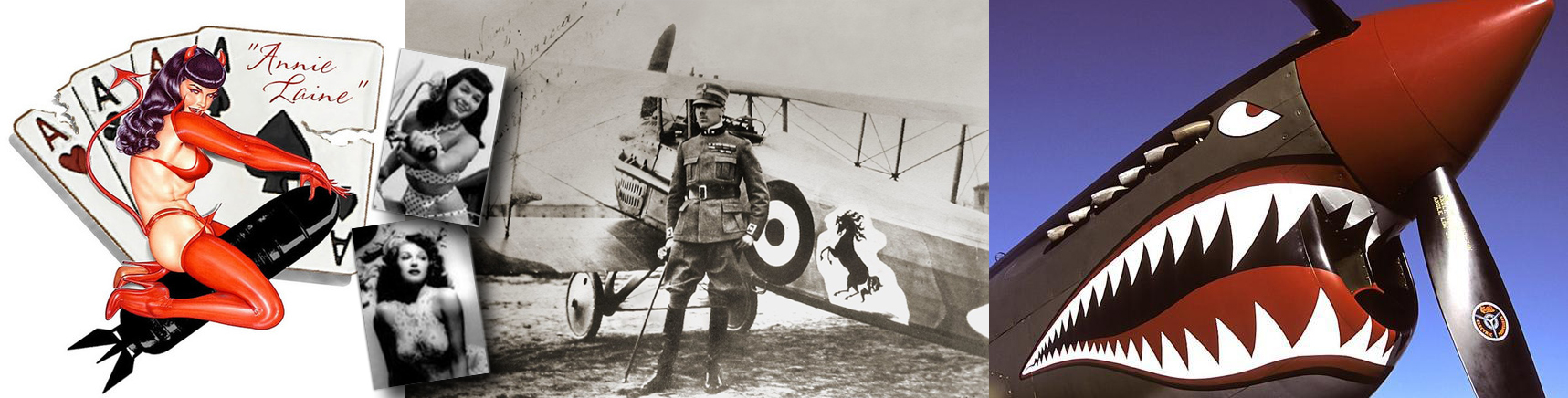
Going beyond simple lettering and pictures, airplane nose art was a form of power, good luck, ownership and a blushing reminder of home for the crews.
The practice of embellishing personalized insignias and decorations on military fighter aircraft was said to have originated with Italian and German pilots with the first recorded piece of nose art being a sea monster painted on the nose of an Italian flying boat in 1913. The idea must have taken on because around that time, the Swedish pioneering aviator, “the flying Baron” Carl Cederström purchased a Donnet-Lévêque sea-biplane for his flying school, Scandinavian Aviatik AB and similarly applied a fish-scaled motif to the craft. Cederström named it “Flygfisken” (Flying Fish).
Actress Charlize Theron unveils her second advertisment for Christian Dior’s J’Adore Eau de Parfum with a little help from manipulated images of Marilyn Monroe, Grace Kelly and Marlene Dietrich.
The new vignette was directed by Oscar-winning director Jean-Jacques Annaud (Black and White in Color, The Name of the Rose}, who directed Brad Pitt in Seven Years In Tibet, for which China decided to refuse Annaud entry into their country for life. It sees Theron, clad in black with obligatory shades, skinnies and stilettoes, racing upstairs into Versailles’ magnificently Hall of Mirrors, then slipping mysteriously through a door. ‘It was incredibly glamorous and fantastic. I don’t think I’ll experience something like that again in my lifetime’ described Theron.
A Dior catwalk show is about to begin and Annaud has captured the pre-show buzz set to the song “Heavy Cross” by The Gossip – the flash of paparazzi cameras and gold invitations, waved like fans by fashion’s great and good who are sitting, buttocks clenched no doubt, on petite gold chairs, quivering with expectancy. So the connection is instantly made with fashion, the point being that the recreation of J’Adore has gone through similar creative steps as that of a couture dress, with countless edits to achieve perfection.
It seems the legendary dead are making a comeback promoting brands and products. There was undead Audrey Hepburn promoting Mars-owned Galaxy chocolate, while Bob Monkhouse was resurrected to highlight the plight of prostate cancer. Revival effects were also used in the commercial for Dior J’Adore, which brought back to life yesteryear’s beauties alongside Charlize Theron. Even earlier than that, Volkswagen and DDB London recreated Gene Kelly’s “Singing in the Rain” for a commercial. And now “The Big Boss” himself is expounding on his philosophy about how to be a game changer.
The campaign was created by ad agency BBH China for Johnnie Walker in the newest iteration of its “Keep Walking” campaign. Celebrating the people he dubs “Gamechangers,” Mr. Lee spouts gems of wisdom, and according to the marketer, himself embodies a gamechanger, way before his time.
The Mill worked on the visual effects to bring Lee back to life, and Joseph Kahn shot the film, which was created in collaboration with the legendary martial artist’s daughter, Shannon. Video footage was initially filmed with Bruce Lee lookalike Danny Chan in Hong Kong. That footage was later blended with a 3D CGI model of Lee based on interviews, films and photographs with the late star. Every shot of Lee’s face was painstakingly created using CGI, a process that took over nine months, due to the level of detail required.
Director Joseph Kahn says that his team tried their best to honor Lee’s spirit by consulting his family. “We got Shannon Lee, Bruce Lee’s daughter, to come aboard and we really picked her brain to make sure that everything was accurate from look to soul,” he says. “We wanted to be as respectful to the man and legend as we could.”
David Gianatasio points out what’s the real problem with this spot.
“Re-enter the dragon? Johnnie Walker and BBH resurrect Bruce Lee via CGI technology (and footage of lookalike actor Danny Chan) for this boring Chinese commercial. The spot, approved by Lee’s daughter Shannon, has proven predictably polarizing. Some critics trot out the old objection that showing dead stars in ads is in poor taste, while others claim the memory of Lee—a paragon of physical fitness and athleticism before his death 40 years ago this month, at age 32—is somehow tarnished by his doppelgänger pitching whisky.
The bigger problem is that the ad is dull, something its inspiration never was. Fake Lee walks around a Hong Kong balcony, runs a hand through some water in a pool and mouths lines like, “Dragons never die, because dragons draw power from water. Water. It’s like instincts … You cannot grasp hold of it. But let it flow and it has the power to change the world.” Dude, drop-kick the faux-losophy … you’re supposed to be Bruce Freakin’ Lee! The guy was a human CGI machine who routinely defied gravity with furiously elegant fighting moves he choreographed himself. How can you bring him back and not put him in motion—shirtless, freaky, fists-and-feet-flying motion!?
Heck, they should have shown CGI Bruce battling barehanded against Undead Audrey Hepburn – or at least something more groovy than what’s on display here. Far from being disrespectful, I believe a highly physical, even frenetic approach would have honored Lee and captured the essence of the man. Bruce Lee was a mischievous badass who reveled in his sensational stunts and brought a transcendent sense of subversive fun to his movies. His violent yet controlled release of kinetic energy forged his connection with audiences around the world. Flying through the air while screaming at the top of his lungs was his defining spiritual statement. Instead, the spirits brand pours us prattle about being a … “game changer”?! Bruce would have demanded such jargon expunged from his film scripts and employed his unshod feet to smack the silly screenwriters upside their heads.
Sadly, the ad fails because Lee is present in body—sort of—but not in spirit.”
Audrey Hepburn has come back to life to flog chocolate. She’s not the first posthumous saleswoman, reports Simon Usborne.
Simon Usborne of The Independent writes “A fictional, yellow celebrity perhaps best summed up the weird lot of the famous dead person. “You celebrities need to realise that the public owns you for life,” Homer Simpson said. “And after you’re dead, you’ll all be in commercials dancing with vacuum cleaners.”
Simpson was referring to Fred Astaire (d.1987) whose controversial, computer-assisted number with a Dirt Devil in 1997 was authorised by his widow but led his daughter to say she was “saddened that after his wonderful career he was sold to the devil”.
Now Audrey Hepburn has become the latest face to be disinterred for promotional purposes, returning to the screen 20 years after her death to advertise a chocolate bar.
A minute-long spot for Galaxy entitled “Choose Silk Chauffeur”, revealed during ITV1’s Mr Selfridge, places a young Hepburn on a bus in traffic on the Amalfi Coast in the 1950s. A Galaxy bar tempts her from her handbag. She makes eyes with a hot man in an open-top, swiftly swapping vehicles before tucking in as they speed away.
This time, Hepburn’s sons, who control her estate, authorised the use of her image, for which they will have received a fee. Sean Ferrer and Luca Dotti say their mother would be “proud” of her new role, adding in a press release that she “often spoke about her love of chocolate and how it lifted her spirit”.
Galaxy Chocolate, a Mars Chocolate brand, teamed up with ad agency AMV BBDO and production company Framestore, to recreate Hepburn in their newest and impressive commercial. Set on Italy’s Amalfi Coast; circa 1950’s, we find the beauty stuck in a bus and desirous of her chocolate. According to Framestore, the production process was arduous and included discovering a Hepburn double, and utilising VFX techniques to form a Computer-Generated Audrey.
Commented Flavia Barbat, Branding Magazine: “The icon’s eyes and smile are said to have been most difficult and, although the Framestore team hoped to utilize real eyes (for which the actress’s similarities were cast), they ended up rebuilding all of Hepburn’s face.”
As for the smile, CG VFX Supervisor, Simon French, states:
“It is amazing how unique and recognizable a person’s smile is. When you see it in this detail, it really needs to look perfect.”
Remarkable execution aside, I am wondering if the visual effects of the commercial will overshadow Galaxy’s branding purposes. Although the aesthetic success of the commercial will bring it all of the publicity it requires, I hope that viewers are capable of comprehending the interaction between the chocolate brand and Hepburn’s legacy. Hepburn is of a Golden Age, a time period that oozes sensuality and luxury, while chocolate consumption is trademarked with parallel descriptors. Beneath the fantastic spectacle of the commercial lies a powerful and well-developed partnership between the one-of-a-kind beauty and Galaxy’s promoted rich, rare taste. After all, the video concludes with the question: Why have cotton when you can have silk?”
For today’s Millenial generation, too young to know her work, seeing a posthumous gamine Hepburn might indeed renew a love of a screen icon of the past. But what’s next after chocolates? Washing detergents… vacuum cleaners?
A more morbid question is raised when Usborne asks, “As the words of the younger Astaire show, the image rights and posthumous fortunes of the departed can lay legal and ethical minefields for brands, and raise the morbid question: who owns dead people?”
When there’s money to be made, may the dead never rest in peace.
The old maxim “If it ain’t broke, don’t change it” holds true for Absolut vodka. Since 1980, the vodka manufacturer has been running essentially the same print advertising campaign where the ads in the campaign make sly reference to Absolut’s distinctive stubby neck and see-through label bottle with tongue-in-cheek variations to the two word tagline.
John Lewis ‘Never Knowingly Undersold’ new TV commercial sets out to prove that what’s really important in life doesn’t change either.
Says the publicity blurb: “The advert is the story of two people falling in love. On the left side of the screen we see the girl’s side of the story. She lives in 1925, the year that John Lewis made its life long commitment to Never Knowingly Undersold. On the right side of the screen we see the boy’s side of the story. He lives in the present day.
By bringing their two worlds together as one, we show that falling in love, and embarking on a relationship, is a universal story which will keep being replayed throughout time. While many aspects of our lives today are very different to almost a century ago, the really important things haven’t changed at all.”
Awww… shucks, that’s so sweeet. But its a clever concept, one that broaches the parameters of time and space and love. Now for some strange reason, I have a sudden craving to see the movie “Back to the Future” again.
The soundtrack is a cover of the INXS song, Never Tear Us Apart, re-recorded by Paloma Faith.
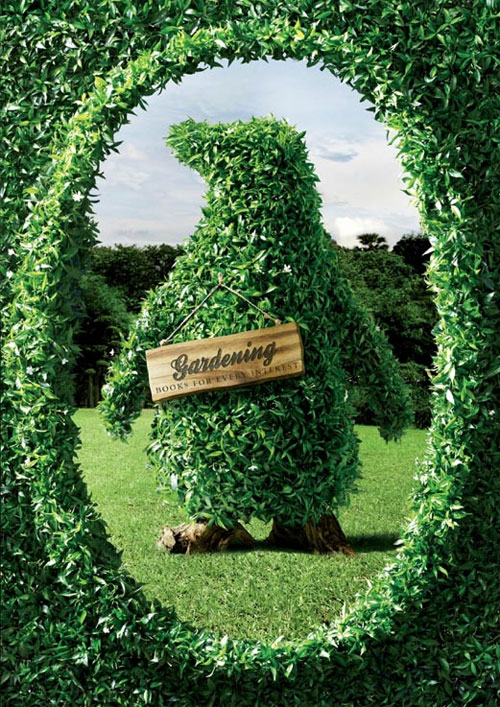
Advertising agency Young & Rubicam, Malaysia is promoting Penguin Books’ range and diversity in this print and poster campaign entitled “More than just the Classics”. Funny, but I absolutely can’t help think of some great ad campaigns involving a particular vodka manufacturer…
A century after it sank after colliding with an iceberg, claiming more than 1,500 lives, the dramatic story of the Titanic – the world’s largest ship at that time – continues to fascinate people around the world. On April 15, 1912, the great ship sank and all that’s left is the wretched wreckage at the bottom of the Atlantic; a debris field stretching about a mile long with items from the period. But her dramatic story continues to fascinate people of all ages, throughout the years, and have been told in countless ways in books, movies and TV specials.
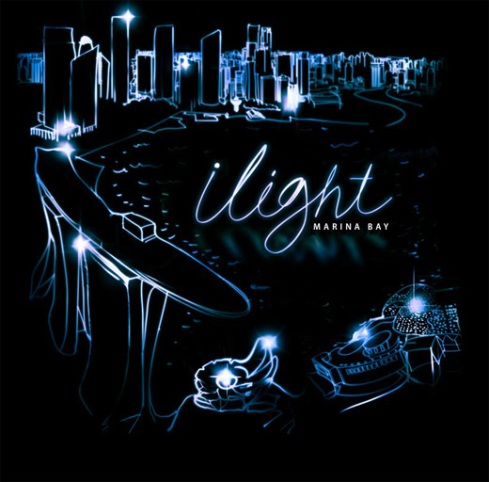
i Light Marina Bay, Asia’s first and only sustainable light art festival was first held from 15 October to 7 November in 2010. The second edition of i Light Marina Bay, themed “Light Meets Asia”, is held from 9 March to 1 April 2012 and features more than 30 innovative and environmentally sustainable light art installations, with a strong focus on works from Asia.
The Festival’s curatorial team is helmed by Festival Director Mary-Anne Kyriakou, and includes two co-curators: Charmaine Toh, a Singapore visual arts curator; and the team from Singapore award-winning design studio FARM. In line with the theme “Light Meets Asia”, the curatorial team has selected the sustainable light art installations from over one hundred submissions. The final selection of installations features a strong representation from new, emerging, and well-known artists from countries across Asia, including Singapore. To find out more about the artists and their installations, click here.
Possibly the world's largest and longest digital Chinese scroll painting!
Last week I went to the largest art exhibition Singapore has ever seen. Spanning 10,000 sq m, the exhibition titled A Moving Masterpiece: The Song Dynasty As Living Art, makes it Singapore’s largest ever art show.
It has, as its centerpiece, the 128 m by 6.5m animated reproduction of Qing Ming Shang He Tu, which was the hit of the China Pavilion at the Shanghai World Expo last year. The digital painting, which features moving and talking characters, has travelled to Hong Kong, Macau and Taipei, delighting over 10 million people. It makes its debut outside Greater China in Singapore. The exhibition boasts educational and interactive elements, created especially to enhance the visitor’s experience.
Titled Dreams and Reality: Masterpieces of Painting, Drawing and Photography from the Musée d’Orsay, Paris, this mega-exhibition from the collection of the world renowned Musée d’Orsay, features over 140 Salon, Realists, Impressionists and Post-Impressionists paintings, photographs and drawings from the mid-19th century to the early 20th century. Slated to run at the National Museum of Singapore from October 26 2011 to February 5 2012, visitors will see works from the likes of the greatest Realist, Impressionist and Post-Impressionist painters: Gustave Courbet, Édouard Manet, Claude Monet, Paul Cézanne and Edgar Degas, to name but a few.
Ai Weiwei and his sunflower seeds. credit: guardian.co.uk
All the ceramic sunflower seeds were weighed in before the installation and must be weighed out again once the exhibition is over.
Autumn 2010 saw the Tate Modern unveiling the latest commission in The Unilever Series, Sunflower Seeds, by the renowned Chinese artist Ai Weiwei. Born in 1957 in Beijing, China, where he lives and works, Ai has exhibited internationally, including recent solo shows at Mori Art Museum, Tokyo; Haus der Kunst, Munich; and has contributed to many group exhibitions around the world, including at the São Paulo Biennial; Documenta 12, Kassel, Germany and Tate Liverpool, UK. Ai also founded the design company Fake Design and co-founded the China Art Archives and Warehouse in Beijing. His work is held in many major collections, including Tate Collection (Table and Pillar 2002).
Courtesy of Gwangju Design Biennale. "Athletic Body Design" - a mural by photographers Howard Schartz and Beverly Ornstein, is included in Gawngju's "Unnamed" category.
The Gwangju Biennale Foundation appointed Seung H-Sang, a Korean architect, and Ai Weiwei, a Chinese artist and architectural designer, as co-directors of the 4th Gwangju Design Biennale. Eight curators and two designers have also been appointed for six major sections of the thematic exhibition. The 4th Gwangju Design Biennale is held at the Biennale Exhibition Hall and throughout the metropolitan city of Gwangju from September 2nd to October 23rd 2011.
Seung H-Sang completed Paju Book City project in Korea, and has gained international recognitions through projects like Guggenheim Pavilion in Abu Dhabi, Chao-Wei SOHO project in Beijing as well as Korea DMZ Peace-Life Valley, the graveyard of late former President Roh Moo-hyun and Commune by the Great Wall. He served as a commissioner of Korean Pavilion for Venice Architecture Biennale in 2008. He operates the architectural firm, Iroje, which he established in 1989.
Ai Weiwei is influential artist, curator, social commentator and activist. His ground-breaking work Sunflower Seeds was recently presented at the Tate Modern Turbine Hall. The work consisted of 100 million porcelain seeds, each individually hand painted by 1,600 Chinese artisans. Ai’s work has been exhibited in the Venice Biennale, Documenta, the Guangzhou Triennial, the Biennale of Sydney among others. He served as creative consultant with the Swiss architectural firm Herzog & De Meuron for their “bird’s nest” Beijing Olympic Stadium project.
The theme of 4th Gwangju Design Biennale is Design is Design is not Design, and is divided into 6 different sections. The theme reinterpret the boundaries between design and non-design, and looks back and explain a variety of design concepts that determine the value of civilized society or are recognized as absolute accessories.
The exhibition theme, inspired by the first words in Tao Te Ching, 道德經 of Lao Tzu, 老子- ‘The way 道 that is the way is not always the way. The name 名 that is the name is not always the name.’, throws a complex question to the viewers with the interpretation of ‘design is design is not always design and non-design is non-design is not always non-design’.
Via ARTINFO, Janelle Zara sat down with writer, editor and curator Brendan McGetrick to discuss putting together the event without Ai Weiwei, the definition of design, and why this festival could only happen in the East.
“The beauty of being in Asia is that a concept like design is much less claustrophobic than in the West, where everyone has an idea of what design is.” Brendan McGetrick
GWANGJU, South Korea— “Svetlana Khorkina, Gymnast, 5’5″, 105 pounds.” This is a label written underneath a life-sized photo of the Russian Olympic gold-medalist, presented in a line of dozens of other athletes along the wall of a gallery at theGwangju Biennale exhibition hall in the city South Korea. Their bodies, all clad in generic black underwear, are short, tall, slender, and bulky, tailored specifically to their respective sports, with their daily exercise and diet regimens listed underneath. Read more…
Inspired by the Royksopp music video “Remind Me”, Thomas Nilsson turns storyteller with his infographic video retelling of the brothers Grimm’s Little Red Riding Hood fairy tale.
From CNET UK comes this animated, infographic video charting the history of the iPhone. Spanning the technological bridge, the infographic video charts how the technological and design developments of the past few decades have influenced the look, feel and features of the different models of iPhone so far. If you want to know what connects the Walkman to Tim Berners-Lee to the NeXTcube, you’ve come to the right place.
Team Singapore at the Opening Ceremony of WorldSkills London 2011, O2 Stadium. 2005 Albert Vidal prize winner Viridis Liew, second from right, escorts the team as it courses its way through the stadium.
With their WorldSkill Team Singapore mascot 'Skilleon' in their arms and waving their flags, the high-spirited competitors of Team Singapore was extremely difficult to miss!
With some 1,000 competitors all over the world competing in 46 WorldSkills international trade skills areas, Team Singapore delivered its most outstanding results to date by bagging 14 WorldSkills Competition medals – 4 Golds, 1 Silver, 2 Bronzes and 7 Medallions for Excellence. Dubbed as the ‘Olympics of Skills’, WorldSkills is a prestigious international biennial trade skills competition with countries sending their best and brightest to compete for honour and glory.
Team Singapore, comprising a record number of 22 competitors from the 5 polytechnics and the Institute of Technical Education (ITE), participated in an unprecedented 19 skills categories, rising above 50 countries at the 41st WorldSkills Competition held in London this year, by finishing in sixth place.
Singapore maintained its unbroken run of Gold Medals at WorldSkills Competition in the nation’s strong events – IT Network Systems Administration (formerly IT-PC & Network Support) and Caring skills categories. Despite being one of the youngest competitors of Team Singapore, Mr Sim Mong Khim, Jared, bagged Singapore‟s sixth straight victory in the IT Network Systems Administration skills category since its debut year in 2001. Ms Li Kaiyun, Jaslyn, and Ms Rachel Chloe Chua also kept Singapore’s winning streak in Caring (Team event) since its inception in 2007, with Golds in 2011, 2009 and 2007. The Best of Nation Award, an accolade for a country’s best performer/s was also awarded to Jaslyn and Rachel; competitors from Nanyang Polytechnic.
Ms Chow Wai Kuan also did Singapore and her institution, Ngee Ann Polytechnic, proud by clinching a Gold Medal in the IT Software Solutions for Business skills category after the four-day competition.
Other firsts in Team Singapore’s results at WorldSkills London 2011: Ms Loh Yi Qi, from Nanyang Polytechnic, excelled in Visual Merchandising, a creatively demanding new skills area unveiled in this installment of WSC, by scoring a Bronze Medal as well. Republic Polytechnic’s first participation in the national contingent has been rewarded with a Bronze Medal through competitor Mr Chan Jun Wei, William, in the Information Network Cabling skills category.






 thinkingouttabox